China’s next-generation Z-21 attack helicopter is attracting growing attention from military analysts after newly released footage offered the clearest look yet at what could become the People’s Liberation Army’s most capable rotary-wing combat platform. The aircraft appears designed to bridge a critical gap in China’s military aviation portfolio by providing a heavier, more survivable attack helicopter optimized for modern high-intensity warfare.
The video, which surfaced online on June 6, 2026, provides a detailed view of a helicopter that appears significantly larger and more capable than the existing Z-10 attack helicopter. While Beijing has yet to officially acknowledge the program or release technical specifications, the visible features suggest a platform engineered for long-range strike missions, armed reconnaissance, air assault escort operations, and combat in heavily defended environments.
A New Generation Beyond the Z-10
For years, the Z-10 has served as the backbone of China’s dedicated attack helicopter fleet. However, the latest imagery indicates that the PLA may be pursuing a more powerful platform capable of carrying heavier weapons loads while offering greater endurance and battlefield survivability.
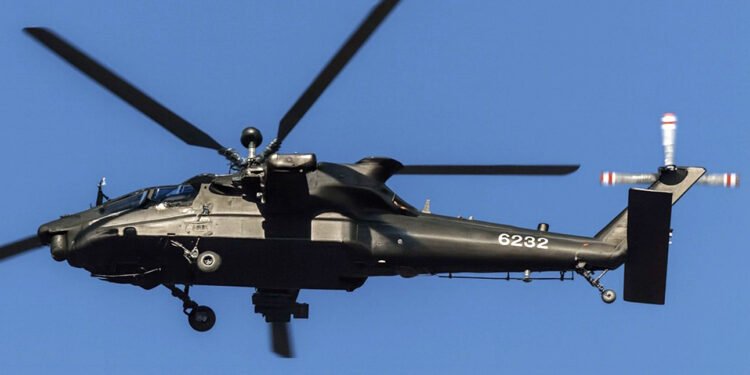
The newly observed aircraft features a noticeably broader fuselage, enlarged engine housings, stronger wing structures, and an overall configuration that places it in a heavier attack helicopter category. Rather than simply being an enlarged version of the Z-10, the Z-21 appears to represent a new design philosophy focused on combining firepower, advanced sensors, and network-centric warfare capabilities.
Analysts believe the helicopter could become a key element of a layered aviation strategy that integrates attack helicopters, assault helicopters, drones, electronic warfare assets, and precision-guided weapons into a single combat ecosystem.
Advanced Sensors and Survivability Features
One of the most striking aspects of the aircraft is its sensor suite. The helicopter’s nose-mounted electro-optical targeting system appears designed to support day-and-night operations through a combination of thermal imaging, television cameras, laser rangefinders, and target-designation equipment.
Additional apertures positioned around the airframe may indicate the presence of a comprehensive defensive aids system. These could include missile warning sensors, radar warning receivers, laser threat detectors, electronic support measures, and countermeasure dispensers designed to improve survivability against modern air-defense networks.
Interestingly, despite speculation that the aircraft might feature a mast-mounted radar similar to that carried by the AH-64 Apache Longbow, available footage provides no definitive evidence of such a system. The circular structure above the rotor hub appears more consistent with rotor assembly fairings than a dedicated radar installation.
This could suggest that China intends to rely more heavily on networked targeting, drone reconnaissance, off-board sensors, and electro-optical systems rather than replicating the Apache’s Longbow radar concept.
The Mystery of the Ventral Module
Among the aircraft’s most intriguing features is a large rectangular structure mounted beneath the forward fuselage. The purpose of this module remains unknown, but its size and integration into the airframe suggest it serves a significant operational role.
Military observers have proposed several possibilities, including a surveillance radar, electronic warfare package, communications relay system, terrain-following sensor, signals intelligence suite, or even an auxiliary fuel module designed to extend operational range.
Should the feature remain part of the final production configuration, it may indicate that the Z-21 is intended to perform a broader range of missions beyond traditional attack helicopter roles.
Expanded Weapons Capacity
The helicopter’s wing design further supports the theory that the Z-21 is intended as a heavy attack platform.
Each stub wing appears capable of carrying three external weapon stations, providing up to six hardpoints in total. Such an arrangement would allow operators to mix anti-tank missiles, guided rockets, air-to-air missiles, reconnaissance equipment, electronic warfare pods, and external fuel tanks depending on mission requirements.
This level of flexibility would exceed that of many existing attack helicopter designs and provide commanders with greater options for adapting to changing battlefield conditions.
Built for Modern Battlefields
The aircraft also appears to incorporate lessons learned from recent conflicts, particularly regarding helicopter survivability.
Its exhaust system seems partially concealed within the upper fuselage structure, a design approach commonly used to reduce infrared signatures by mixing hot exhaust gases with cooler rotor downwash before dispersal. Such measures can help decrease vulnerability to infrared-guided missiles.
The importance of these features has become increasingly evident in modern conflicts, where helicopters face threats from portable air-defense systems, drones, electronic warfare assets, and radar-guided weapons. Survivability today depends not only on armor and maneuverability but also on advanced sensors, electronic protection systems, and the ability to engage threats from greater stand-off distances.
Working Alongside the Z-20T
The Z-21 is likely to operate in close coordination with China’s Z-20T assault helicopter rather than replacing it. While the Z-20T is designed primarily for troop transport, air assault operations, and battlefield mobility, the Z-21 appears optimized for escort missions, anti-armor warfare, route security, armed reconnaissance, and suppressing enemy defenses.
In a typical operation, Z-20T helicopters could transport troops into contested areas while Z-21 gunships secure flight routes, eliminate threats, and provide close air support throughout the mission.
Strategic Importance Across Multiple Theaters
Although much discussion focuses on potential operations in the Taiwan Strait, the helicopter’s significance extends far beyond any single scenario.
The Z-21 could prove especially valuable in China’s western regions, where mountainous terrain and high altitudes place heavy demands on rotary-wing aircraft. Increased power, payload capacity, and endurance would provide meaningful advantages in such environments compared with existing attack helicopter platforms.
This dual utility suggests the aircraft may be intended to support both large-scale air assault operations and sustained combat missions in difficult geographic conditions.
Still Many Unknowns
Despite the growing visibility of the program, critical details remain unavailable. There is currently no confirmed information regarding the helicopter’s engines, maximum weight, combat range, armor protection, onboard radar systems, weapon integration, or production status.
It is also unclear whether the aircraft seen in the footage represents an early prototype, a development platform, or a configuration close to operational service.
As a result, analysts continue to treat assessments of the Z-21 with caution. Visible design features can provide valuable clues about intended roles and capabilities, but they cannot substitute for verified technical data.
A Significant Step in China’s Helicopter Evolution
Even with many questions unanswered, the latest footage offers the strongest indication yet that China is developing a new class of heavy attack helicopter.
Its larger airframe, expanded weapons capacity, sophisticated sensor arrangements, survivability-focused design, and potential multi-role capabilities suggest a platform intended to operate at the center of future PLA air assault and battlefield support operations.
If eventually fielded, the Z-21 could mark an important evolution in Chinese army aviation, complementing existing Z-10 attack helicopters and Z-20 assault platforms while strengthening the PLA’s ability to conduct complex, high-intensity operations across a wide range of combat environments.