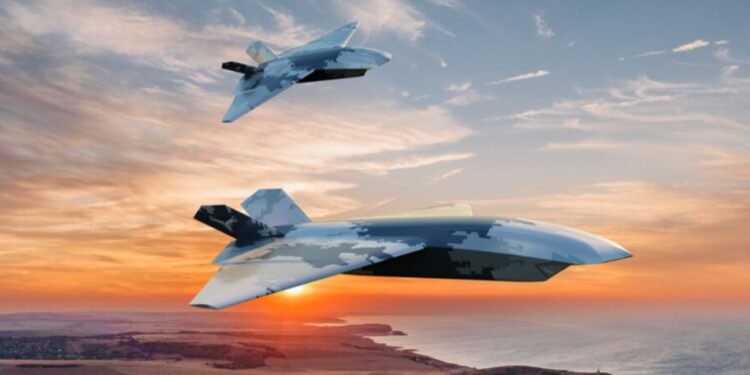
The United Kingdom has launched the Storm Fighter program, a new initiative aimed at developing autonomous Collaborative Combat Aircraft (CCA), commonly known as “loyal wingman” drones, that will operate alongside the Royal Air Force’s crewed fighter fleet. The program represents Britain’s latest step toward integrating uncrewed systems into future air combat operations and is expected to support aircraft such as the Eurofighter Typhoon, F-35B Lightning II, and the future Global Combat Air Programme (GCAP) fighter.
Announced by the Royal Air Force, the Storm Fighter program revives the UK’s collaborative combat aircraft ambitions following the cancellation of the earlier Project Mosquito in 2022. Rather than pursuing a single large uncrewed aircraft, the new initiative focuses on developing a family of autonomous systems tailored for a range of combat missions.
As part of the program, the RAF unveiled two new drone concepts. The Storm Chrome platform is designed to conduct electronic warfare missions, including radar jamming and suppression of enemy air defenses, while Storm Fire is intended as a long-range, one-way attack drone capable of striking high-value targets deep inside contested airspace. Together, these aircraft are expected to extend the reach, survivability, and combat effectiveness of manned fighter formations.
The Storm Fighter initiative forms part of the UK’s broader vision of building what British officials describe as Europe’s first sixth-generation air force. The concept emphasizes manned-unmanned teaming, where autonomous aircraft perform high-risk missions such as reconnaissance, electronic attack, decoy operations, and precision strikes while remaining under human supervision. This approach aims to reduce risks to pilots while increasing the flexibility and firepower of future air operations.
The program also complements the Global Combat Air Programme (GCAP), the multinational effort involving the United Kingdom, Japan, and Italy to develop a sixth-generation stealth fighter expected to enter service around 2035. Loyal wingman aircraft are envisioned as key force multipliers for the future GCAP platform, enabling coordinated operations between crewed and autonomous systems on the modern battlefield.
Defense analysts believe the launch of Storm Fighter reflects a broader shift in military aviation toward autonomous and AI-enabled combat systems. Similar loyal wingman programs are already underway in countries including the United States and Australia, underscoring the growing importance of collaborative combat aircraft in future air warfare.
With the Storm Fighter program now underway, the United Kingdom is seeking to strengthen its position at the forefront of next-generation air combat, combining advanced fighters with intelligent autonomous drones to create a more capable, survivable, and networked force for the decades ahead.