Russia’s aerospace industry has once again highlighted its ambitions for the Su-75 Checkmate, a next-generation stealth fighter designed to bring fifth-generation combat capabilities to a wider range of air forces at a significantly lower cost than existing Western alternatives.
Speaking about the future of the program, senior officials from Russia’s aircraft manufacturing sector outlined the long-term objectives of the Su-75, emphasizing affordability, export potential, and advanced combat capabilities. The aircraft is being positioned as a lightweight, single-engine stealth fighter capable of performing air superiority, strike, reconnaissance, and multi-role missions while remaining considerably cheaper to acquire and operate than many competing platforms.
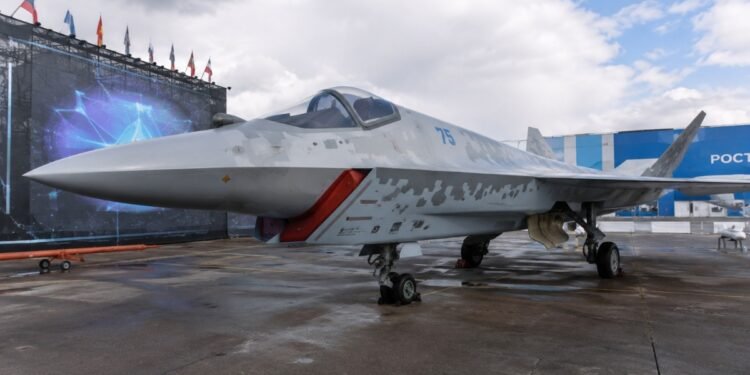
First unveiled at the MAKS Air Show in 2021, the Su-75 Checkmate was introduced as a new generation combat aircraft intended to complement Russia’s heavier twin-engine Su-57 fighter. Unlike the Su-57, which was designed primarily to meet Russian military requirements, the Checkmate has been heavily marketed toward international customers seeking modern stealth capabilities without the financial burden associated with larger fifth-generation fighters.
According to Russian aerospace officials, the core vision behind the program is to create a fighter that combines stealth characteristics, advanced avionics, artificial intelligence-assisted decision support, and network-centric warfare capabilities in a package accessible to a broader customer base. The aircraft is expected to feature internal weapons bays, reduced radar cross-section, advanced sensor fusion, and compatibility with a wide range of precision-guided munitions.
A key selling point of the Su-75 remains its projected affordability. Russian industry representatives have repeatedly argued that many countries require advanced air combat capabilities but lack the resources to procure expensive Western stealth fighters. By focusing on a single-engine design and streamlined manufacturing approach, developers hope to significantly reduce acquisition and lifecycle costs while maintaining competitive performance.
The Checkmate’s design incorporates several features associated with modern stealth aircraft, including angular shaping, concealed weapon storage, and a diverterless supersonic inlet intended to minimize radar reflections. The aircraft is also expected to employ advanced digital systems that would allow pilots to process battlefield information more efficiently while operating in highly contested environments.
Russian officials have further indicated that the platform could eventually evolve into a family of aircraft. Concepts previously presented by developers have included two-seat versions, carrier-capable adaptations, and even unmanned variants designed to operate alongside manned combat aircraft. Such flexibility could broaden the aircraft’s appeal in international markets.
Despite the ambitious goals, the Su-75 program continues to face significant challenges. While the aircraft has generated considerable attention since its unveiling, a flying prototype has yet to be publicly demonstrated. Questions also remain regarding development timelines, production capacity, funding, and export opportunities amid ongoing geopolitical and economic pressures affecting Russia’s defense industry.
Analysts note that transforming the Checkmate from a promising concept into an operational fighter will require substantial investment and successful flight-testing. The global fighter market is increasingly competitive, with countries weighing cost, capability, industrial partnerships, and long-term support when selecting next-generation combat aircraft.
Nevertheless, Russian officials remain optimistic about the project’s future. They argue that demand exists for a stealth fighter that can deliver advanced capabilities without the price tag associated with premium Western platforms. If the program progresses as planned, the Su-75 could emerge as one of the most affordable fifth-generation fighter options available on the international market.
For now, the Checkmate remains a vision of Russia’s future combat aviation ambitions—one that seeks to combine stealth, affordability, and export appeal into a single platform. Whether it can ultimately fulfill those ambitions will depend on the program’s ability to move from concept to operational reality in the years ahead.