The aircraft the U.S. Air Force had been preparing to phase out unexpectedly became the centerpiece of America’s largest air campaign in decades.
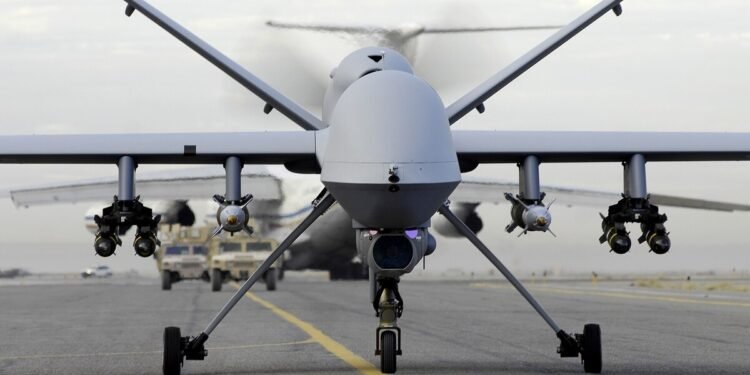
During testimony before the House Armed Services Committee on May 20, Air Force Chief of Staff Gen. Kenneth S. Wilsbach described the MQ-9 Reaper as “perhaps the most valuable player” of Operation Epic Fury, the six-week U.S.-Israeli military campaign against Iran that began on February 28, 2026. Coming from a veteran fighter pilot known for advocating crewed aviation, the assessment carried significant weight. According to Wilsbach, no other platform came close to matching the Reaper’s contribution.
Yet while the drone proved indispensable in combat, its success highlighted a growing problem. The fleet has suffered heavy losses, production has already ended, and the Air Force is now accelerating efforts to field a replacement. The Reaper’s greatest triumph may also have exposed its greatest vulnerability.
Operation Epic Fury: A Landmark Air Campaign
On February 28, 2026, the United States and Israel launched a large-scale coordinated offensive against Iran. Known as Operation Epic Fury by the United States and Operation Roaring Lion by Israel, the campaign targeted key elements of Iran’s military infrastructure, including missile facilities, strategic command networks, naval assets, and sites connected to its nuclear program.
Over the course of six weeks, U.S. forces struck more than 13,000 targets across Iran before a ceasefire brought the operation to an end in early April. The campaign represented the most extensive American air operation since the 1991 Gulf War and served as a real-world test of modern airpower concepts.
Why the MQ-9 Became the Campaign’s Workhorse
The MQ-9 Reaper earned its reputation during Epic Fury largely because of one capability: persistence.
Unlike most combat aircraft, the Reaper can remain airborne for more than 24 hours, allowing it to continuously monitor targets and maintain intelligence coverage over vast areas. At the height of the operation, roughly a dozen Reaper patrols were reportedly operating over Iran simultaneously.
These drones played a crucial role in tracking mobile missile launchers, monitoring naval activity, and providing commanders with uninterrupted intelligence from the Persian Gulf, the Strait of Hormuz, and western Iran’s missile corridors. Their ability to stay on station for extended periods gave military planners a level of situational awareness that would have been difficult to achieve with conventional aircraft alone.
Equally important, the Reaper reduced risk to aircrews. Throughout the campaign, U.S. manned aircraft avoided combat losses, underscoring the growing value of unmanned systems in high-risk operations.
Air Force leaders have repeatedly emphasized that drones will play a larger role in future military operations. Secretary of the Air Force Troy Meink told lawmakers that the future force structure will rely heavily on a combination of manned and unmanned platforms, describing that approach as essential to future airpower.
A High Price for Success
While the Reaper delivered exceptional battlefield results, those achievements came with substantial losses. Reports indicate that at least 42 U.S. military aircraft were either destroyed or damaged during the conflict with Iran. Of those losses, 24 were MQ-9 Reapers.
The financial impact is significant. With each Reaper valued at tens of millions of dollars, the destroyed aircraft represent losses approaching $1.2 billion. Ironically, that figure exceeds the funding currently sought for some next-generation unmanned aircraft initiatives.
The losses also severely reduced the size of the operational fleet. The Air Force entered fiscal year 2026 with more than 180 MQ-9s across active-duty and Air National Guard units. However, combat attrition in Iran, combined with earlier losses to Houthi attacks in Yemen, has reduced the inventory to approximately 135 aircraft.
That number is particularly concerning because it falls well below the Air Force’s long-established minimum requirement of 189 aircraft, leaving the service with a substantial capability gap.
The Production Problem
The situation is made even more challenging by the fact that new MQ-9s are no longer being built.
After the Air Force signaled the end of future MQ-9 purchases, General Atomics shut down the production line in 2025. Available replacement aircraft are extremely limited, with fewer than ten new or company-owned airframes reportedly available.
Reopening a closed production line is neither quick nor inexpensive. Industry experts estimate that restarting production could require years of preparation and hundreds of millions of dollars in investment.
One possible short-term solution is the acquisition of the MQ-9B SkyGuardian, an upgraded successor to the original Reaper. However, procurement decisions remain unresolved, and available aircraft would not be sufficient to rapidly rebuild the fleet.
Congress Questions Air Force Spending Priorities
The Reaper’s performance has also sparked debate in Washington. Despite the platform’s critical role in Epic Fury, Air Force budgets continue to allocate the majority of aircraft procurement funding toward crewed fighter programs. Members of Congress are increasingly questioning whether current spending priorities reflect the lessons learned during the conflict.
Lawmakers have pressed Pentagon officials to explain why investment strategies appear disconnected from battlefield realities, particularly after a drone platform outperformed many of the service’s more expensive aircraft during a major war.
As discussions surrounding the fiscal 2027 and 2028 defense budgets intensify, the balance between manned and unmanned systems is emerging as one of the most important issues in defense planning.
Building the Reaper’s Successor
Recognizing the urgency of the situation, the Air Force formally advanced plans for a replacement platform in May 2026. Major General Christopher Niemi outlined the requirements for the future system, emphasizing open architecture, rapid manufacturing, affordability, and the ability to absorb combat losses. Rather than focusing exclusively on survivability, the next-generation drone is being designed around the concept of “affordable mass.”
This represents a major shift in thinking. Previous concepts prioritized stealth and advanced survivability features to penetrate heavily defended airspace. The new approach accepts that losses are inevitable in modern warfare and instead focuses on producing larger numbers of lower-cost systems that can be replaced quickly.
The replacement effort is expected to follow a model similar to the Collaborative Combat Aircraft program, which encourages competition, rapid prototyping, autonomous capabilities, and modular designs that can evolve over time.
A Turning Point for American Air Power
Operation Epic Fury has fundamentally reshaped the debate surrounding unmanned aviation. First, it confirmed the strategic importance of drones in modern warfare. When the Air Force’s top officer identifies an unmanned aircraft as the most valuable asset in a major campaign, the argument for their importance becomes difficult to dispute.
Second, the conflict exposed the limitations of expensive and difficult-to-replace platforms. Although the Reaper proved highly effective, its losses demonstrated the risks associated with relying on systems that cannot be replenished quickly during a prolonged conflict.
Third, the shrinking fleet highlights a serious readiness concern. With limited replacement options and no active production line, rebuilding capacity will take years. Analysts believe the resulting capability gap could persist well into the next decade.
Conclusion
The MQ-9 Reaper’s experience during Operation Epic Fury is one of the most striking contradictions in modern military aviation. A platform once viewed as a candidate for retirement became the defining aircraft of America’s largest air campaign in more than three decades.
At the same time, that success came at a considerable cost. Twenty-four Reapers were lost, the fleet has dropped below operational requirements, and production has already ceased.
The Air Force’s new replacement program signals a major shift in strategy—one that prioritizes quantity, adaptability, and affordability over the pursuit of a small number of highly expensive platforms. Whether that approach can deliver a capable successor quickly enough remains one of the most pressing questions facing U.S. defense planners.
What is no longer in doubt is the role of unmanned systems in future warfare. After Operation Epic Fury, the discussion is no longer about whether drones will dominate future air campaigns—it is about how rapidly the United States can build the next generation.