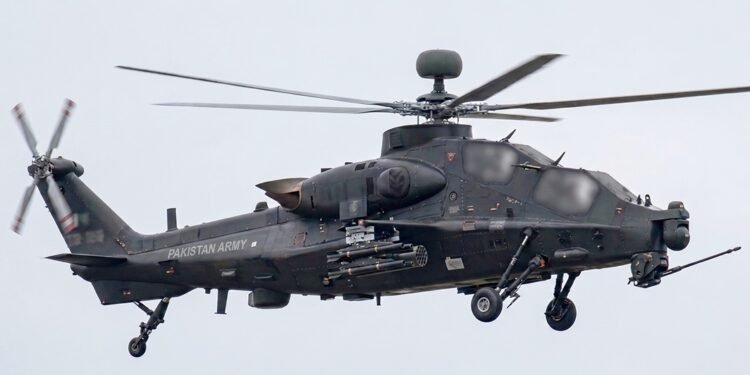
Pakistan has reportedly signed a contract to acquire 30 Chinese-made Z-10ME attack helicopters, potentially marking a major milestone in the modernisation of Pakistan Army Aviation. The reported deal could significantly strengthen Pakistan’s close-air-support and anti-armour capabilities.
According to a report published by the South China Morning Post (SCMP) on November 2, 2026, an image circulating on Chinese social media reportedly shows China National Aero-Technology Import and Export Corporation (CATIC) signing a contract with Pakistan’s Ministry of Defence Production for 30 Z-10ME helicopters, including associated products and services.
1. Pakistan’s Reported 30-Helicopter Deal
The reported contract could explain the scale of Pakistan’s Z-10ME acquisition, which remained unclear following the helicopter’s official induction into Pakistan Army Aviation in August 2025.
Previously, Pakistan had reportedly explored acquiring up to 40 helicopters from China’s Z-10 family. The newly reported figure of 30 aircraft suggests a potentially substantial procurement programme.
2. What Makes the Z-10ME Special?
The Z-10ME is an export-oriented, upgraded version of China’s Z-10 attack helicopter, developed by Changhe Aircraft Industries Corporation.
Its reported improvements include:
– Enhanced cockpit and critical-system armour.
– Missile approach warning systems.
– Radar and laser warning receivers.
– Electronic countermeasure capabilities.
– Improved sensors and targeting equipment.
– Compatibility with guided air-to-ground weapons.
– Mast-mounted millimetre-wave radar on the export configuration.
These features are intended to improve survivability and battlefield effectiveness in demanding combat environments.
3. Weapons and Combat Capabilities
The Z-10 family can employ different categories of weapons, depending on configuration and integration.
Potential weapons include:
– Anti-tank guided missiles for engaging armoured vehicles.
– CM-502KG-class precision strike weapons.
– TY-90 short-range air-to-air missiles.
– 23mm cannon for close-range engagements.
– Unguided and guided rocket systems.
The precise Pakistani Z-10ME weapons configuration has not been publicly established.
4. Why Pakistan Needs These Helicopters
Pakistan has faced difficulties with previous attack-helicopter procurement programmes. Its efforts to acquire American AH-1Z Viper helicopters and Turkish T129 ATAK helicopters encountered major obstacles, including export restrictions affecting the T129’s engine.
The Z-10ME offers Pakistan an alternative without depending on US export approval for the helicopter itself. It could gradually strengthen or supplement Pakistan’s ageing AH-1F Cobra fleet and improve Army Aviation’s ability to support ground forces.
5. Strategic Implications for India
If the reported acquisition of 30 helicopters is confirmed, it could have several implications for the regional military balance.
1. Anti-armour capability: Improved ability to engage armoured formations and ground targets.
2. Close air support: Greater support for Pakistani ground formations.
3. Mountain operations: Potentially useful in difficult terrain, although high-altitude performance with operational weapons and fuel loads requires further assessment.
4. Air defence challenges: Indian ground forces may need to account for a larger modern attack-helicopter capability.
However, the actual battlefield impact will depend on training, maintenance, weapons availability and operational readiness.
The reported acquisition of 30 Chinese Z-10ME attack helicopters could represent an important development in Pakistan’s military modernisation. After unsuccessful attempts to procure American and Turkish attack helicopters, China appears to have become an important alternative supplier for Pakistan’s Army Aviation requirements.
Nevertheless, the reported 30-aircraft figure remains unconfirmed. The next major milestone will be an official announcement or independently verifiable evidence of the contract and delivery programme.