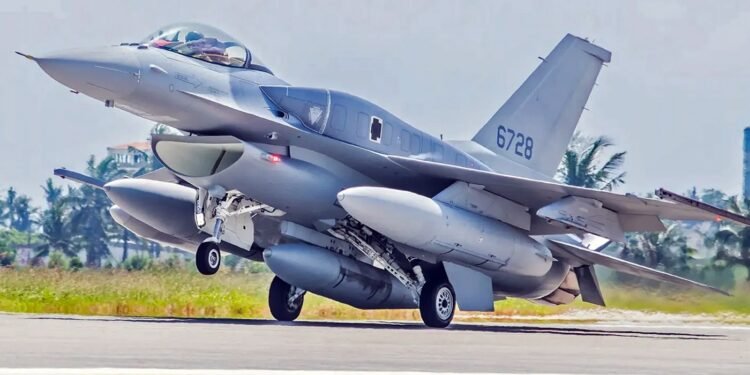
Taiwan has taken delivery of the first two newly built F-16V Block 70 fighter jets from a 66-aircraft order placed with the United States, marking the beginning of a long-delayed modernization program for the island’s fighter fleet.
The two aircraft arrived at Chihhang Air Base in Taitung, after flying through Hawaii and Guam. The arrival represents the first delivery under Taiwan’s roughly $8 billion procurement agreement approved by Washington in 2019.
The aircraft, identified by tail numbers 6727 and 6728, landed at the eastern Taiwan air base around noon local time. Their arrival came approximately a month later than initially anticipated, following delays that affected the delivery schedule.
A Long-Delayed Fighter Program
Taiwan originally secured U.S. approval in August 2019 to purchase 66 new F-16C/D Block 70 aircraft, designated F-16V. The program, known locally as the “Peace Phoenix Soaring” project, carries an estimated value of NT$247.2 billion, or approximately $8 billion.
After nearly seven years of waiting, Taiwan has received the first two aircraft from its long-delayed purchase of 66 new-build F-16C/D Block 70 fighters pic.twitter.com/Lecrq7QzbZ
— PAF Falcons (@PAFFalconsPK) October 3, 2026
The program encountered several obstacles, including production-line relocation and restart requirements, supply-chain disruptions and software-related issues. These challenges pushed deliveries beyond the original schedule.
The first two aircraft eventually departed the United States in August and made their way across the Pacific before arriving in Taiwan.
Taiwanese officials have indicated that additional aircraft are expected to follow, although the precise delivery schedule has not been publicly detailed.
A Major Upgrade for Taiwan’s Fighter Force
The F-16V Block 70 represents a substantial advancement over Taiwan’s older F-16A/B fleet. The new fighters are equipped with the Northrop Grumman AN/APG-83 AESA radar, providing improved detection and tracking capabilities compared with earlier mechanically scanned radar systems.
The aircraft are also designed to incorporate the AN/ALQ-254(V)1 Viper Shield electronic warfare system, while their GE F110-GE-129 engines can produce up to 29,500 pounds of thrust. Conformal fuel tanks further increase fuel capacity and can extend the aircraft’s operational endurance.
Other improvements include the Joint Helmet Mounted Cueing System II, advanced mission systems and strengthened landing gear designed to support higher operating weights.
Together, these upgrades give the F-16V Block 70 a significantly more modern combat architecture, particularly for beyond-visual-range engagements and operations in environments where electronic warfare is a major factor.
Expanding Taiwan’s F-16 Fleet
Taiwan already operates a substantial F-16 fleet. It has upgraded 139 older F-16A/B aircraft to the F-16V standard, meaning the arrival of the 66 new Block 70 aircraft will eventually take the island’s total F-16 inventory to more than 200 fighters.
The new fighters are expected to operate from Chihhang Air Base in Taitung, strengthening Taiwan’s military presence on its eastern side.
The location is significant because Taiwan’s eastern coastline provides strategic depth while also facing the possibility of air and maritime operations around the island. The arrival of the Block 70 fleet will therefore add another modern fighter component to Taiwan’s broader air-defense network.
Weapons and Mission Flexibility
The F-16V Block 70 can employ a broad range of air-to-air and air-to-ground weapons. Taiwan’s planned weapons portfolio includes AIM-9X and AIM-120D air-to-air missiles, alongside weapons such as AGM-88 anti-radiation missiles, AGM-154C glide weapons, JDAM precision-guided munitions and Harpoon anti-ship missiles.
The aircraft’s 11 external stations allow it to carry a combination of weapons, fuel tanks and other mission equipment. Its increased fuel and payload capacity can support missions extending beyond traditional air-policing and interception duties.
This gives Taiwan the option of employing the F-16V in air-defense, maritime strike and precision-attack missions, depending on operational requirements.
What the First Two Jets Mean
The arrival of aircraft 6727 and 6728 is only the beginning of Taiwan’s 66-jet acquisition. Once the entire order is delivered, the new Block 70s will form an important part of Taiwan’s modern fighter fleet alongside its upgraded F-16V aircraft.
For Taiwan, the program also represents continuity with an aircraft family its pilots and maintenance personnel already operate. Rather than introducing an entirely new fighter type, the Block 70 builds upon an existing F-16 infrastructure while adding newer radar, electronic warfare, propulsion, weapons and mission-system capabilities.
The first two aircraft therefore mark more than the arrival of a pair of fighters. They signal the start of a major expansion of Taiwan’s modernized F-16 force after years of production and delivery delays.
With 64 more aircraft still to arrive, the full impact of the program will depend on how quickly the remaining fighters are delivered and integrated into operational service.