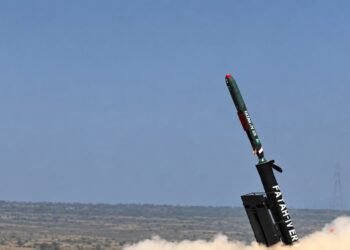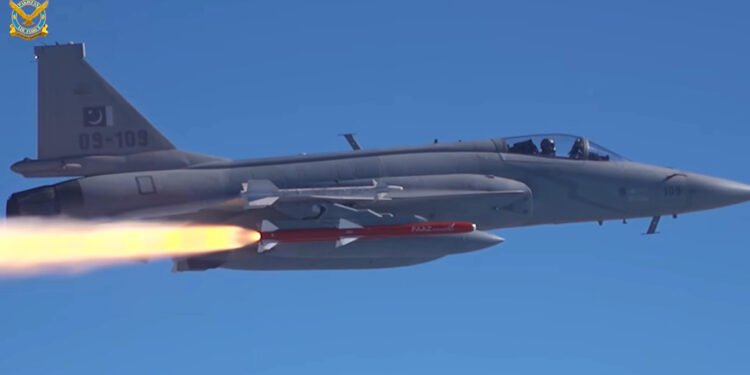
Pakistan has taken an important step towards developing its own advanced air-to-air weapons with the successful flight test of the indigenous Fa’az air-to-air missile, launched from a JF-17 Thunder fighter.
Pakistan’s Inter-Services Public Relations (ISPR) announced the successful flight test, describing Fa’az as the country’s first indigenously developed air-to-air missile. The announcement represents a significant development in Pakistan’s efforts to strengthen its domestic aerospace and defence industry.
The test is particularly important because it demonstrates that Pakistan’s indigenous missile programme has progressed beyond the public display of development models and reached flight testing from an operational fighter aircraft.
1. Fa’az Missile: Pakistan’s Indigenous Air-to-Air Weapon
The Fa’az missile programme has been publicly known since 2023, when Pakistan’s Global Industrial & Defence Solutions (GIDS) displayed missile models at the International Defence Industry Fair (IDEF) in Türkiye.
The programme is associated with Pakistan’s National Engineering and Scientific Commission (NESCOM) and its Air Weapons Complex (AWC).
The Fa’az family has been presented with two principal air-to-air configurations:
– Fa’az-IIR: Equipped with an imaging infrared seeker.
– Fa’az-RF: Equipped with an active radar-homing seeker.
Pakistan successfully tests its first indigenously developed air-to-air missile Fa’azhttps://t.co/QM7l16FP67 pic.twitter.com/YdefMPdfuV
— PAF Falcons (@PAFFalconsPK) November 4, 2026
These two configurations offer different approaches to target acquisition and terminal guidance, potentially giving the Pakistan Air Force greater flexibility in future air combat operations.
2. JF-17 Thunder: The Platform Behind the Test
The released footage shows a Pakistan Air Force JF-17 Thunder Block I, serial number 09-109, carrying and launching the Fa’az missile.
This is noteworthy because the JF-17 is central to Pakistan’s combat aviation modernisation and its ambition to develop a stronger domestic aerospace industry.
Testing an indigenous missile from the JF-17 demonstrates progress towards integrating locally developed weapons with a Pakistani-operated fighter platform.
It could eventually provide the PAF with greater flexibility in weapons integration, maintenance, upgrades and future development.
People who lost Rafale to J-10C are extremely busy in calling Fa'az BVRM a copy of PL-12/SD-10A while simply forgetting the fact that PL-12 is Active radar homing BVR missile while Fa'az-I [The Tested Variant] is Imaging Infrared [IIR] based BVR missile.
This same ignorant… pic.twitter.com/PFhf6QD69B
— PAF Falcons (@PAFFalconsPK) November 8, 2026
However, the first launch should not be confused with full operational integration. Additional testing, compatibility assessments and certification will be necessary before the missile can be considered operationally ready.
3. Fa’az-IIR vs Fa’az-RF: Understanding the Two Guidance Systems
The most interesting aspect of the Fa’az programme is its reported dual-seeker architecture.
Fa’az-IIR – Imaging Infrared Guidance
The IIR configuration uses an imaging infrared seeker to identify and track a target through its thermal signature.
Its potential advantages include:
– Passive terminal guidance without active radar emissions from the missile.
– Reduced dependence on conventional radar-homing engagement.
– Potential resistance to some forms of radar-based countermeasures.
– Additional tactical flexibility when combined with suitable offboard targeting information.
Fa’az-RF – Active Radar Guidance
The RF configuration uses an active radar seeker to detect and track its target during the terminal engagement phase.
Potential advantages include:
– Autonomous terminal target acquisition.
– All-weather engagement potential.
– Greater flexibility against targets without a strong infrared signature.
– Compatibility with mid-course guidance updates, subject to the final system configuration.
The two variants could complement one another rather than compete directly. However, their actual performance will depend on seeker quality, guidance software, electronic counter-countermeasures and integration with the aircraft’s sensors.
4. Why Is Fa’az Important for the Pakistan Air Force?
Pakistan already operates several foreign-developed air-to-air missile systems, including:
– AIM-120 AMRAAM for its F-16 fleet.
– PL-12-family missiles for Chinese-origin aircraft.
– PL-15E long-range BVR missiles for the J-10CE and JF-17 Block III.
The development of Fa’az introduces another important dimension: domestic control over air-to-air weapon development.
Its potential advantages include:
Reduced foreign dependence: Domestic development could reduce exposure to international export restrictions and supply-chain disruptions.
Weapons integration: Pakistan could gain greater control over future missile upgrades and integration with its aircraft.
Industrial development: The programme can strengthen local expertise in propulsion, seekers, guidance systems and missile electronics.
Export opportunities: A domestically supported missile could eventually become an additional selling point for the JF-17 Thunder in international defence markets.
These benefits will depend on Pakistan’s ability to manufacture, maintain and continuously upgrade the missile at scale.
5. What Does Fa’az Mean for the JF-17 Thunder?
The JF-17 Thunder has become an important component of Pakistan’s airpower and defence-export strategy. Its development has involved cooperation between Pakistan and China, while Pakistan has progressively expanded its domestic manufacturing and maintenance capabilities. The introduction of Fa’az could represent another stage in this industrial development.
The JF-17 Block III, with its modern AESA radar, advanced avionics and electronic warfare capabilities, offers a particularly interesting platform for future integration of indigenous BVR weapons. Nevertheless, the first publicly demonstrated Fa’az launch involved a Block I aircraft, not a Block III. Future integration with the Block III would require dedicated testing and certification.
6. Strategic Implications for South Asian Airpower
The Fa’az programme has implications beyond the JF-17. India has developed its indigenous Astra air-to-air missile family, while China continues to advance its PL-series missile technology. Pakistan’s development of an indigenous BVR missile introduces another dimension to the regional airpower competition.
For Pakistan, the objective is not necessarily to replace every imported missile immediately. Instead, developing a domestic capability could provide greater freedom to upgrade its weapons inventory and reduce dependence on external suppliers.
The programme also has an industrial dimension: countries capable of developing sophisticated air-to-air missiles possess valuable expertise in aerospace engineering, electronics, propulsion and precision guidance.
7. Conclusion: A Significant Step Towards Defence Independence
Pakistan’s successful flight test of the Fa’az air-to-air missile marks an important milestone in the country’s aerospace and defence development.
For the Pakistan Air Force, the programme represents an opportunity to develop a domestically supported BVR weapons capability, complement existing Chinese and American missile systems, and strengthen the long-term technological foundation of the JF-17 Thunder programme.
However, the real measure of success will be determined by further testing, operational reliability, seeker performance, production capacity and eventual induction. Fa’az is more than another missile development project. It represents Pakistan’s ambition to move from importing advanced air-to-air weapons towards developing and producing its own.