China has announced a significant breakthrough in naval aviation after its GJ-21 stealth unmanned combat aerial vehicle (UCAV) reportedly completed its first successful takeoff and landing aboard the People’s Liberation Army Navy’s (PLAN) newest Type 076 amphibious assault ship, Sichuan.
Announced on October 30, 2026, the milestone demonstrates China’s growing ambition to operate advanced stealth unmanned aircraft from large maritime platforms. It could also mark an important step towards a new generation of drone-equipped naval forces.
According to China’s Xinhua News Agency, citing a naval source, the GJ-21 successfully conducted shipborne flight operations during the Sichuan’s recent sea trials.
1. What is China’s GJ-21 stealth drone?
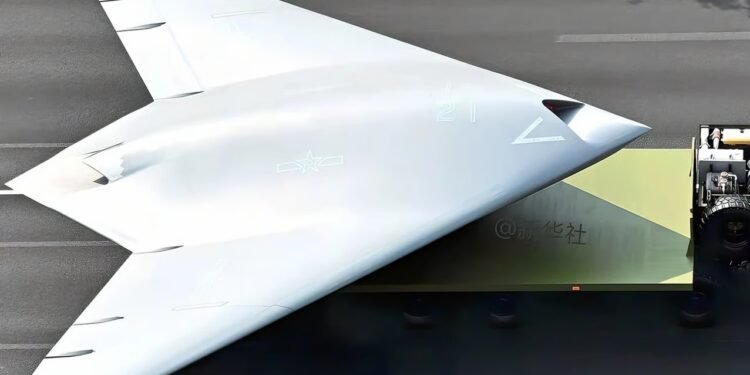
The GJ-21 is a navalised stealth reconnaissance and strike drone believed to be derived from China’s GJ-11 Sharp Sword unmanned combat aircraft.
It features a flying-wing configuration designed to reduce radar visibility while providing sufficient internal space for fuel, sensors and weapons.
Its naval configuration incorporates several important modifications:
– Foldable wings: Allow more efficient storage aboard ships.
– Arresting hook: Enables recovery using shipboard arresting cables.
– Catapult launch system: Allows the aircraft to take off from a relatively short flight deck.
– Stealth configuration: Designed to reduce radar detection.
– Reconnaissance and strike capability: Intended to support intelligence gathering and precision attack missions.
The aircraft was publicly displayed during China’s September 2025 military parade.
2. Type 076 Sichuan: China’s emerging drone carrier
The GJ-21’s achievement is particularly significant because of the ship involved. The Sichuan, hull number 51, is China’s first Type 076 amphibious assault ship. Launched on December 27, 2024, it represents a major development in China’s naval aviation capabilities.
Unlike conventional amphibious assault ships, the Type 076 incorporates electromagnetic catapult and arresting technologies. These systems make it possible to operate larger fixed-wing unmanned aircraft that cannot simply take off vertically or use a conventional helicopter flight deck.
China is effectively exploring a new category of naval vessel: an amphibious assault ship with substantial drone-carrier capabilities.
3. Why is the GJ-21’s first shipborne landing important?
Operating a stealth drone from a naval vessel is considerably more complicated than flying it from a conventional airbase.
The aircraft must successfully manage:
– Catapult-assisted launch.
– Navigation over the sea.
– Communication with ship-based control systems.
– Precise approach to a moving flight deck.
– Arrested landing and recovery.
– Safe aircraft handling and storage.
Successfully demonstrating these operations would establish an important foundation for future unmanned naval aviation. However, a first successful trial does not automatically mean the aircraft has achieved full operational readiness.
4. What missions could the GJ-21 perform?
The GJ-21 could potentially perform several important missions.
A. Maritime reconnaissance
Its stealth characteristics could help it conduct intelligence, surveillance and reconnaissance missions in contested maritime environments.
B. Precision strike
The aircraft could potentially carry internally mounted precision-guided weapons to attack selected targets.
C. Suppression of enemy air defences
Stealthy unmanned aircraft could potentially support operations against enemy radar installations and air-defence systems.
D. Support for manned fighters
The GJ-21 could eventually operate alongside China’s J-35 and other naval aircraft, providing additional reconnaissance and strike capabilities. These are potential mission applications rather than publicly demonstrated operational capabilities.
5. What does this mean for US naval aviation?
China’s development is particularly interesting when compared with the American X-47B programme.
The US Navy previously demonstrated carrier-based unmanned aircraft technology through the X-47B, including autonomous carrier takeoff and landing.
However, the programme did not progress into an operational combat drone fleet.
China’s GJ-21 programme now appears to be moving towards an actual shipborne unmanned combat aviation capability.
This could create a new competitive dimension between the US Navy and PLAN, particularly in carrier aviation, autonomous systems and maritime strike operations.
6. Important limitations: What has not been confirmed?
Despite the significance of this announcement, several important details remain undisclosed.
– The exact date and location of the flight tests.
– The number of successful takeoffs and landings.
– The GJ-21’s operational combat radius.
– Its maximum payload and weapon configuration.
– Its endurance and autonomous flight capabilities.
– Whether the aircraft has entered regular operational service.
Importantly, China has not released independently verifiable footage of the actual GJ-21 shipborne takeoff and landing. Janes has highlighted this evidence gap, noting that publicly released footage appears to include computer-generated imagery.
Conclusion: China moves closer to the era of drone carriers
China’s reported GJ-21 shipborne flight demonstration represents an important milestone in the evolution of naval warfare. The combination of a stealth unmanned combat aircraft, electromagnetic catapult and arrested-recovery technology gives the Type 076 Sichuan a potentially important role in China’s future naval aviation strategy.
If China successfully develops this capability into a reliable operational system, the GJ-21 could become an important component of future Chinese maritime reconnaissance, precision-strike and manned-unmanned teaming operations.