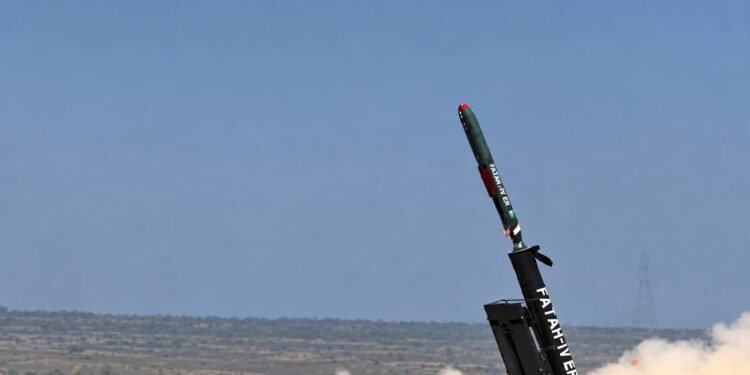
Pakistan has successfully conducted the test launch of an extended-range version of its indigenously developed Fatah-4 Ground-Launched Cruise Missile (GLCM), marking another step forward in the country’s domestic precision-strike and missile-development capabilities.
The test was conducted on October 6, 2026, with the Pakistan Army’s Inter-Services Public Relations (ISPR) confirming the successful launch. According to ISPR, the latest variant incorporates advanced avionics and state-of-the-art navigational aids, allowing the weapon system to engage targets at extended ranges with high precision and lethality.
Improved Accuracy and Survivability
Beyond demonstrating the missile’s extended-range capability, the latest trial was intended to validate additional technical parameters of several upgraded subsystems.
ISPR said these improvements are aimed at enhancing the missile’s accuracy and survivability, potentially increasing its effectiveness against targets at greater distances. The military did not publicly disclose the maximum range of the extended version during the announcement.
The emphasis on survivability is particularly significant for a ground-launched cruise missile. Such weapons generally seek to exploit low-altitude flight profiles and advanced navigation to complicate detection and interception, although specific operational characteristics of the new Fatah-4 extended version have not been officially detailed.
Witnessed by Army Officers, Scientists and Engineers
The test was witnessed by senior Pakistan Army officers along with scientists and engineers from the organization responsible for developing the missile. Pakistan’s political and military leadership welcomed the successful trial. President Asif Ali Zardari, Prime Minister Shehbaz Sharif, Chief of Army Staff and Chief of Defence Forces Field Marshal Syed Asim Munir, and the services chiefs congratulated the teams involved and praised their technical expertise and commitment.
The National Assembly also described the test as an important advancement in Pakistan’s indigenous defence technology and highlighted the role of local scientists, engineers and defence specialists in the programme.
Building on the Fatah-4 Programme
The latest launch follows Pakistan’s earlier testing of the Fatah-4 system. In September 2025, the Pakistan Army conducted a training launch of the Fatah-4 at a reported range of 750 kilometres. The system was described as a precision land-attack cruise missile designed to strengthen Pakistan’s conventional long-range strike capabilities.
Pakistan Tested FATAH-IV Extended Ranage Version. Reported Ranage is around 1000 to 1200km pic.twitter.com/uuBHThBhR0
— PAF Falcons (@PAFFalconsPK) October 7, 2026
A further Fatah-4 test was conducted by the Army Rocket Force Command in May 2026, demonstrating that the programme has continued to progress through successive testing and development stages. The introduction of an extended version suggests that Pakistan is continuing to refine the missile’s range, guidance, navigation and survivability characteristics rather than relying solely on an increase in range.
What the Fatah-4ER Test Means
The successful test represents another development in Pakistan’s effort to build a more capable indigenous conventional precision-strike arsenal.
An extended-range cruise missile can provide greater stand-off capability, allowing launch platforms to engage targets from farther away while reducing their exposure to opposing defensive systems. Improvements to navigation, accuracy and survivability could further enhance the missile’s effectiveness in a contested environment.
However, the exact range, warhead configuration, propulsion improvements and detailed guidance architecture of the extended Fatah-4 variant remain undisclosed by Pakistan. Therefore, claims circulating about a specific new maximum range should be treated cautiously until officially confirmed.
The Fatah-4ER test nevertheless demonstrates that Pakistan’s indigenous missile programme continues to evolve, with the latest trial focusing not only on greater reach but also on precision, survivability and upgraded onboard systems.