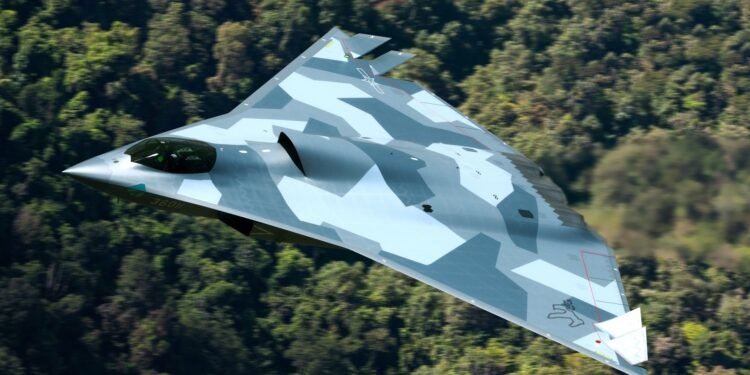
Fresh images circulating on Chinese social media have sparked renewed interest in the country’s next-generation combat aircraft program, with defense analysts suggesting they may show a fifth prototype of the J-36. While Chinese authorities have not officially confirmed the aircraft’s identity or development status, the latest imagery appears to reveal a more refined configuration, indicating that the program is progressing through iterative flight testing.
The aircraft, widely referred to by observers as the J-36, is believed to be a sixth-generation fighter demonstrator under development by Chengdu Aircraft Corporation (CAC). Since the first sightings of the aircraft, successive appearances have fueled speculation that China is accelerating work on advanced combat aviation technologies intended to define future air superiority.
According to open-source analysts, the newest prototype appears to incorporate several visible refinements compared with earlier aircraft. These include smoother fuselage contours, cleaner integration between the wing and center fuselage, possible adjustments to the engine inlets, and subtle changes around the aircraft’s trailing edges. Although these observations remain unconfirmed, such modifications are consistent with the normal evolution of advanced flight-test programs as engineers refine aerodynamic performance, structural integrity, and low-observable characteristics.
The tailless configuration continues to be one of the aircraft’s most distinctive features. Eliminating conventional vertical stabilizers can reduce radar signature while improving stealth performance, but it also requires highly sophisticated flight-control software and advanced digital flight systems to maintain stability and maneuverability throughout the flight envelope.
Analysts also believe the aircraft’s unusually large airframe could support missions extending well beyond traditional fighter operations. The design may provide space for increased internal fuel capacity, larger internal weapons bays, advanced sensor suites, electronic warfare equipment, and collaborative combat systems capable of coordinating with unmanned aircraft. These assessments are based on the aircraft’s observed configuration rather than official Chinese disclosures.
Another notable aspect of the reported design is its apparent three-engine arrangement, a feature rarely seen on modern fighter aircraft. While no official technical details have been released, observers suggest the configuration could provide the electrical power and thrust needed to support next-generation sensors, long-range operations, directed-energy technologies, or other advanced mission systems that are expected to play an increasingly important role in future air combat.
China has released very little official information about the J-36 program, leaving most analysis dependent on photographs, videos, satellite imagery, and expert assessments from open sources. As a result, many of the aircraft’s projected capabilities—including its propulsion system, sensor suite, performance, and intended operational role—remain speculative until confirmed through official announcements.
The continued appearance of what appear to be progressively refined prototypes nevertheless suggests that China’s next-generation combat aircraft program is advancing through a structured test and evaluation process. Each new sighting offers additional clues about Beijing’s ambitions in sixth-generation aviation, an area of increasing competition as major military powers invest in future combat aircraft capable of integrating stealth, artificial intelligence, advanced networking, electronic warfare, and human-machine teaming.
Although significant questions remain unanswered, the emergence of another possible J-36 prototype highlights the pace of China’s aerospace development and underscores the growing strategic importance of sixth-generation fighter technologies in shaping the future balance of airpower in the Indo-Pacific and beyond.