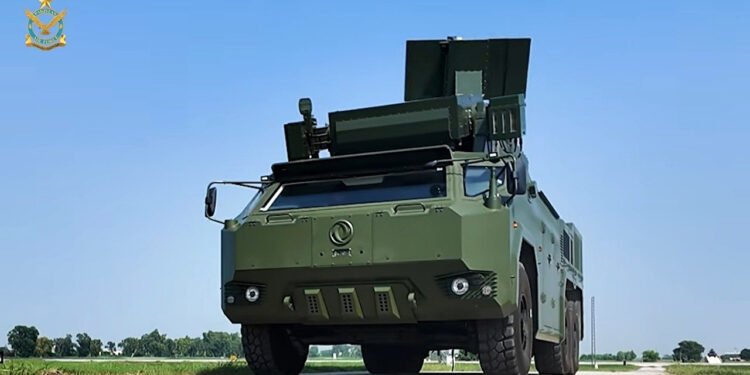
ISLAMABAD: The Pakistan Air Force (PAF) has publicly showcased what appears to be China’s HQ-17AE short-range surface-to-air missile system, providing the first widely reported visual indication that the Chinese air-defense system has entered Pakistan’s inventory.
The system appeared briefly in a new PAF promotional video released around Pakistan Air Force Day. Defense publications subsequently identified the vehicle as the export version of China’s HQ-17 mobile short-range air-defense system.
A New Layer in Pakistan’s Air Defense
The HQ-17AE is designed as a highly mobile air-defense system capable of accompanying maneuvering forces. Its combination of search and tracking sensors with vertically launched missiles allows it to respond rapidly to low-altitude aerial threats.
HQ-17 is a Highly Mobile Air Defense System, designed to Provide Close Protection against Low-altitude Aerial Threats.
Equipped with 8x Ready-to-Fire Missiles, it can Engage Targets like Aircraft, Helicopters, UAVs and Cruise Missiles UpTo 15–20km, while its Onboard Search and… pic.twitter.com/DQfiLEVeMw
— PAF Falcons (@PAFFalconsPK) September 8, 2026
According to published specifications, the system uses a 6×6 wheeled chassis, carries eight ready-to-launch missiles, can track multiple targets simultaneously and is designed to engage several targets at the same time.
Its mobility is particularly significant. Rather than functioning solely as a fixed air-defense battery, a system of this type can move with protected formations and provide short-range coverage against threats approaching at low altitude.
Countering Drones and Low-Level Threats
The appearance of the HQ-17AE comes as modern air forces increasingly rely on drones, loitering munitions, cruise missiles and other low-altitude weapons.
Chinese military analysts cited by Global Times described the system as potentially helping Pakistan address a short-range air-defense gap and improve protection against low-altitude threats, particularly unmanned systems.
For Pakistan, this could complement longer-range air-defense systems rather than replace them. The PAF already operates Chinese-origin systems including the HQ-9 family, while other reported acquisitions are intended to provide additional layers of coverage.
What Has Pakistan Officially Confirmed?
There is an important distinction between what has been shown and what has been formally announced.
The PAF’s promotional material displayed the vehicle, but available reporting indicates that Pakistan has not publicly announced the system’s designation, number of units, contract value or delivery schedule. Chinese state media and specialist defense outlets have identified it as the HQ-17AE.
Therefore, describing Pakistan as having “shown” or “apparently acquired” the HQ-17AE is currently more defensible than claiming that Islamabad has officially announced a specific procurement quantity.
Strengthening the PAF’s Layered Air Defense
If the identification is confirmed, the HQ-17AE would add another short-range layer to Pakistan’s increasingly diversified integrated air-defense architecture.
The system’s principal value would not be its ability to replace long-range SAMs, but its potential to protect airbases, command facilities, maneuvering forces and other high-value assets from threats that penetrate longer-range defenses.
The development also reflects the increasingly close defense relationship between Pakistan and China, with Chinese aircraft, missiles, radars and air-defense systems becoming important components of Pakistan’s modernization program.
The appearance of the HQ-17AE therefore represents more than another missile system. It points toward a more layered and mobile Pakistani air-defense network designed to cope with the growing threat from drones, precision-guided weapons and low-altitude attack systems.