Türkiye’s indigenous KAAN fifth-generation fighter program has reached another significant milestone after the P1 prototype successfully completed powered taxi tests, marking a crucial step toward its maiden flight. The latest trials demonstrate continued progress in one of the country’s most ambitious aerospace and defense projects as Turkish Aerospace Industries (TUSAŞ) expands the aircraft’s flight-test campaign.
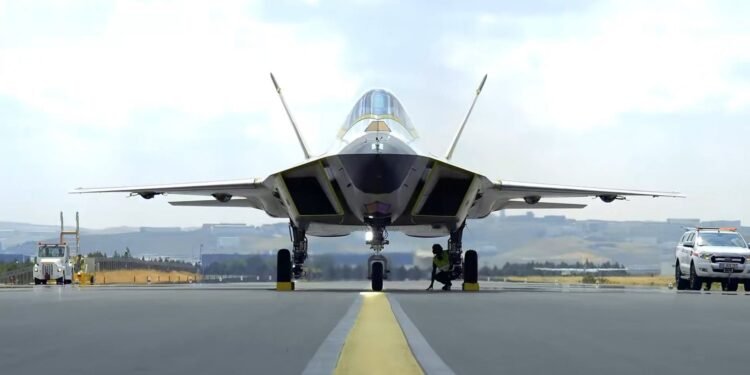
Footage released by Turkish Aerospace Industries (TUSAŞ) shows the P1 prototype taxiing under its own power at increasing speeds along the runway. Powered taxi tests are a critical phase of aircraft development, allowing engineers to evaluate engine performance, braking systems, steering, flight controls, hydraulics, avionics integration, and overall aircraft handling before authorizing a first flight.
The P1 aircraft differs from the original P0 prototype that made the KAAN’s maiden flight in February 2024. According to Turkish officials and aviation analysts, the newer prototypes incorporate a more representative production configuration with refinements to the airframe, onboard systems, and avionics. The expanded prototype fleet is intended to accelerate testing, reduce development risks, and support the program’s planned transition toward serial production.
The KAAN is being developed as Türkiye’s next-generation air superiority fighter to eventually replace the Turkish Air Force’s aging F-16 fleet. Designed with low-observable characteristics, advanced sensor fusion, network-centric warfare capabilities, and multirole mission flexibility, the aircraft represents the centerpiece of Türkiye’s long-term effort to establish an indigenous combat aviation industry. Early prototypes continue to use General Electric F110 engines while Türkiye works on developing the indigenous TF35000 engine for future production aircraft.
Powered taxi testing is one of the final stages before a new aircraft enters flight testing. During this phase, engineers verify that propulsion, flight-control software, landing gear, braking performance, and safety systems function as expected under realistic operating conditions. Successful completion of these tests brings the P1 prototype significantly closer to its first flight, which industry observers expect to take place after additional ground evaluations are completed.
The KAAN program has attracted growing international attention as Türkiye seeks to establish itself among the limited number of countries capable of designing and producing advanced combat aircraft. Recent export interest, including agreements with international partners, highlights Ankara’s ambition to position the KAAN as a competitive option in the global fighter market alongside other emerging fifth-generation platforms.
With the P1 prototype now progressing through dynamic ground testing and additional prototypes expected to join the flight-test campaign, the KAAN program is entering a more intensive phase of development. The coming months will be closely watched by the aerospace community, as the aircraft moves toward expanding its flight envelope and validating the technologies that will shape Türkiye’s future air combat capabilities.