Turkish drone manufacturer Baykar reached a major milestone in unmanned warfare by successfully conducting a live-fire test of the Bayraktar TB3 Unmanned Combat Aerial Vehicle (UCAV) armed with Roketsan’s IHA-122 supersonic missile. The trial marked a groundbreaking achievement, demonstrating the ability of a carrier-capable drone to engage a distant maritime target with precision while operating in coordination with another unmanned aircraft.
The test highlighted the growing sophistication of Türkiye’s indigenous defense technologies and showcased the potential of networked drone operations in modern combat. By combining advanced unmanned platforms, high-speed precision weapons, and real-time battlefield coordination, the exercise underscored a significant evolution in naval and expeditionary warfare.
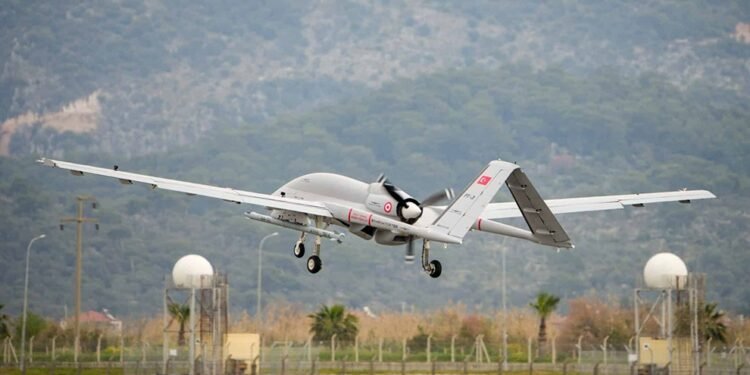
The Bayraktar TB3 occupies a unique position within Türkiye’s expanding drone portfolio. Designed specifically for operation from short-runway naval vessels, including the Turkish Navy’s flagship TCG Anadolu, the aircraft features foldable wings that enable deployment from sea-based platforms where conventional fixed-wing aircraft cannot operate. This capability allows Türkiye to project air power far beyond its coastline without relying on traditional land-based airfields.
As a Medium-Altitude Long-Endurance (MALE) combat drone, the TB3 boasts a wingspan of 14 meters and a maximum takeoff weight of around 1,450 kilograms. It is capable of flying above 30,000 feet and remaining airborne for more than 24 hours. Equipped for both intelligence, surveillance, reconnaissance, and strike missions, the drone can carry up to 280 kilograms of payload, including a range of precision-guided weapons. Its satellite communication system enables beyond-line-of-sight operations, a crucial feature for long-range missions launched from naval platforms.
The weapon used during the test, the IHA-122, is a supersonic air-launched missile developed from Roketsan’s TRG-122 guided artillery rocket family. Powered by a solid-fuel rocket motor, the missile can achieve high speeds while delivering accurate strikes through its laser-guided terminal seeker. With an effective range exceeding 50 kilometers when launched from unmanned aerial vehicles, the IHA-122 is designed to engage both fixed and moving targets at extended distances.
Although previous trials saw the missile integrated with larger UAVs such as the Bayraktar Akıncı, this event represented its first successful employment from the carrier-capable Bayraktar TB3. The achievement expands the operational flexibility of the Turkish Armed Forces by providing a fast, cost-effective strike option without exposing manned aircraft to enemy defenses.
Another notable aspect of the exercise was the cooperation between the Bayraktar TB2 and TB3 drones. The successful coordination between the two platforms demonstrated Türkiye’s progress in network-centric warfare, where multiple unmanned systems share information and execute complementary battlefield roles. Such interoperability enhances mission effectiveness, increases survivability, and enables more flexible operational planning in complex combat environments.
The test also serves as an important step toward future concepts such as autonomous strike formations and coordinated drone swarms. As Baykar continues to integrate new weapons and capabilities into the TB3 platform, the aircraft is expected to play a central role in future naval and expeditionary missions.
This latest accomplishment reflects the rapid advancement of Türkiye’s defense industry. Over the past decade, the country has transformed itself from a buyer of foreign drone technology into a leading developer and exporter of combat-proven unmanned systems. The successful integration of indigenous missiles, advanced networking capabilities, and carrier-based operations further strengthens Türkiye’s position among the world’s foremost innovators in unmanned warfare.