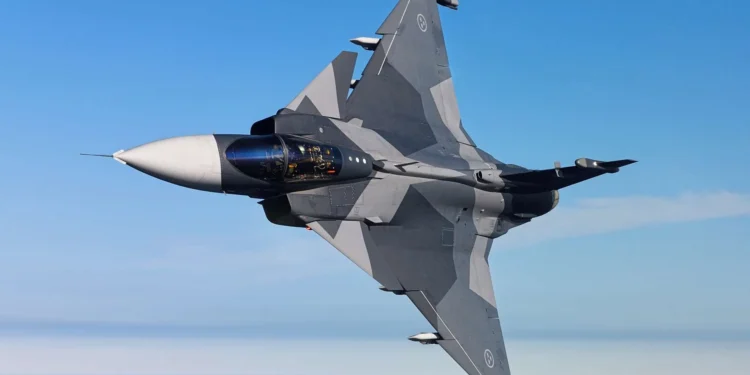
Ukraine is preparing for a major transformation of its air combat capabilities through a planned acquisition of up to 20 Saab Gripen E/F fighter jets from Sweden under Stockholm’s newly approved Support Package 22. Announced on May 28, 2026, the agreement represents one of the most significant modernization efforts undertaken by the Ukrainian Air Force since the start of the war with Russia and could eventually position Ukraine among Europe’s largest operators of Western tactical combat aircraft.
The proposed deal will be financed through a €2.5 billion European Union Ukraine Support Loan, while Sweden has also authorized the future transfer of up to 16 Gripen C/D fighters from existing Swedish Air Force inventories beginning in 2027. Together, the package offers Kyiv a long-term pathway toward building a modern, scalable, and highly survivable air combat force tailored for operations inside one of the world’s most heavily contested electronic warfare environments.
The Gripen E/F is widely regarded as one of the few modern fighters specifically designed for sustained combat operations under conditions similar to those currently faced by Ukraine. Built around Sweden’s Cold War-era Bas 90 operational doctrine, the aircraft was engineered to survive attacks on traditional airbases by operating from dispersed highway strips, damaged runways, and improvised forward locations using small maintenance teams and limited logistical infrastructure.
This operational philosophy has become increasingly relevant in Ukraine, where Russian missile and drone strikes have repeatedly targeted fixed airbases, fuel depots, maintenance centers, and command facilities since the beginning of the conflict. The Gripen’s ability to rapidly relocate, refuel, rearm, and launch follow-up sorties from decentralized locations offers a major survivability advantage in such an environment.
The agreement follows a letter of intent signed in October 2025 in Linköping between Swedish Prime Minister Ulf Kristersson and Ukrainian President Volodymyr Zelenskyy regarding a possible long-term Ukrainian requirement for between 100 and 150 Gripen E fighters. If realized, such a fleet would surpass every previous Gripen export order combined and significantly reshape European tactical airpower balance.
At the same time, Sweden has approved procurement of replacement Gripen E fighters for its own air force to compensate for the future transfer of older Gripen C/D aircraft to Ukraine. However, production timelines remain constrained because Saab is already fulfilling domestic Swedish and Brazilian orders while facing bottlenecks involving engine manufacturing, avionics integration, and supplier chain capacity.
Although visually similar to earlier Gripen variants, the Gripen E/F incorporates major technological upgrades. The aircraft uses the General Electric F414-GE-39E engine, delivering substantially greater thrust compared to the RM12 engine powering earlier Gripen C/D models. Internal fuel capacity has also been significantly increased, improving combat endurance and operational range while allowing the aircraft to carry heavier mission payloads.
The fighter supports a broad selection of advanced weapons including:
- Meteor missiles
- IRIS-T
- AIM-120 AMRAAM
- Taurus KEPD 350
- Precision-guided bombs
- Anti-ship weapons
- Reconnaissance pods
The Meteor missile, in particular, would significantly improve Ukraine’s beyond-visual-range combat capability. Unlike traditional rocket-powered missiles, Meteor employs a throttleable ramjet propulsion system that maintains energy deep into the engagement envelope, providing greater no-escape zones against enemy aircraft.
The Gripen E/F also stands out for its advanced electronic warfare and sensor architecture. The aircraft integrates the Leonardo ES-05 Raven AESA radar featuring a repositionable swashplate antenna for expanded off-axis target coverage, while the Skyward-G infrared search and track system allows passive detection of enemy aircraft without emitting radar signals.
Complementing these systems is Saab’s sophisticated Arexis electronic warfare suite, which combines:
- Digital radar warning receivers
- Active jamming systems
- Emitter geolocation capability
- Automated countermeasure deployment
- 360-degree situational awareness
These capabilities are especially important for Ukraine, where Russian electronic warfare systems such as Krasukha, Zhitel, Tirada, Pole-21, and Murmansk-BN have been extensively employed to disrupt navigation, communications, drones, and aviation operations.
The Gripen E/F was specifically designed to continue operating even under degraded GPS coverage, disrupted data links, and intense electromagnetic interference — conditions that closely mirror the Ukrainian battlefield.
Ukraine’s future transition plan will reportedly unfold in two stages. Initial efforts will focus on integrating Gripen C/D fighters beginning in 2027, followed by gradual introduction of newly manufactured Gripen E/F aircraft from around 2030 onward. Swedish authorities have already confirmed that pilot and technical training programs for Ukrainian personnel are underway and expected to expand significantly over the coming years.
One of the biggest long-term challenges, however, remains industrial production capacity. Sweden originally ordered 60 Gripen E fighters, while Brazil separately acquired 36 aircraft under an earlier agreement involving local production and technology transfer. A future Ukrainian requirement potentially reaching 100 to 150 fighters would place enormous pressure on Swedish aerospace manufacturing infrastructure and global supplier networks.
https://x.com/PAFFalconsPK/status/2037256732351881592?s=20
Nevertheless, the growing demand for the Gripen reflects how modern conflicts are increasingly rewarding aircraft optimized for dispersal, rapid regeneration, survivability, and electronic warfare resilience rather than reliance on large centralized airbases.
For Ukraine, the Gripen E/F offers far more than a new fighter jet. It represents a strategic shift toward a modern NATO-compatible air combat ecosystem capable of surviving and operating effectively in one of the most challenging warfare environments of the modern era.