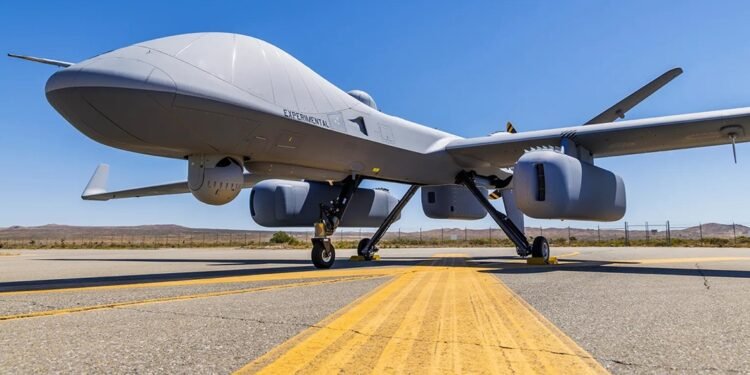
The integration of an airborne early warning (AEW) radar onto the MQ-9 Reaper unmanned aerial vehicle is emerging as one of the most significant developments in military aviation, potentially transforming the role of drones from intelligence-gathering assets into airborne command-and-control platforms capable of extending battlefield awareness across vast distances.
Traditionally known for surveillance and precision-strike missions, the MQ-9 Reaper has become a cornerstone of modern military operations. However, the addition of advanced airborne early warning capabilities could dramatically expand its operational value, enabling the drone to detect, track, and monitor aerial and maritime threats while supporting manned and unmanned forces in real time.
The concept centers on equipping the MQ-9 with a sophisticated radar system capable of performing functions traditionally reserved for larger and more expensive Airborne Warning and Control System (AWACS) aircraft. By carrying an AEW radar, the MQ-9 could provide long-range detection of enemy aircraft, cruise missiles, drones, and surface vessels while simultaneously feeding targeting and situational awareness data to friendly forces.
One of the key advantages of using the MQ-9 as an airborne early warning platform is persistence. Unlike conventional AWACS aircraft that require large crews and significant operational support, the MQ-9 can remain airborne for more than 24 hours, allowing it to maintain continuous surveillance over critical regions for extended periods. This endurance could prove invaluable in monitoring contested airspace, maritime chokepoints, or active conflict zones.
The growing threat posed by low-flying cruise missiles, swarms of unmanned aircraft, and stealth platforms has increased demand for distributed sensing networks capable of providing early warning from multiple locations. A network of MQ-9s equipped with AEW radars could create a layered surveillance architecture, improving threat detection while reducing reliance on a small number of high-value airborne command aircraft.
Such a capability would also enhance joint operations. Data collected by MQ-9 AEW platforms could be shared with fighter aircraft, naval vessels, ground-based air-defense systems, and command centers, creating a more comprehensive operational picture. This networked approach aligns with the military’s broader vision of multi-domain operations, where information superiority plays a decisive role in combat effectiveness.
Another significant benefit is survivability through distribution. Traditional AWACS aircraft are highly capable but represent valuable and potentially vulnerable assets. Deploying multiple MQ-9-based radar platforms spreads sensing capabilities across a wider area, making it more difficult for adversaries to disrupt battlefield awareness with a single strike.
The emergence of drone-based airborne early warning systems also reflects broader trends in military modernization. Armed forces around the world are increasingly exploring how unmanned systems can perform missions once considered exclusive to large manned aircraft. Advances in radar miniaturization, artificial intelligence, sensor fusion, and secure communications are making these new operational concepts increasingly feasible.
For the United States and its allies, an MQ-9 equipped with AEW capabilities could provide a cost-effective supplement to existing airborne surveillance fleets while enhancing coverage in regions where maintaining continuous AWACS presence may be challenging. The platform could be particularly valuable in maritime security missions, border surveillance operations, and expeditionary deployments where flexibility and endurance are essential.
While significant technical and operational challenges remain, including radar integration, power generation, data processing, and survivability in contested environments, the concept represents a major step forward in the evolution of unmanned aviation.
If successfully fielded, an MQ-9 Reaper carrying an airborne early warning radar would not simply be an upgraded drone—it could become a force multiplier capable of extending the reach of air-defense networks, improving situational awareness, and reshaping how future air operations are conducted in increasingly complex and contested battlespaces.