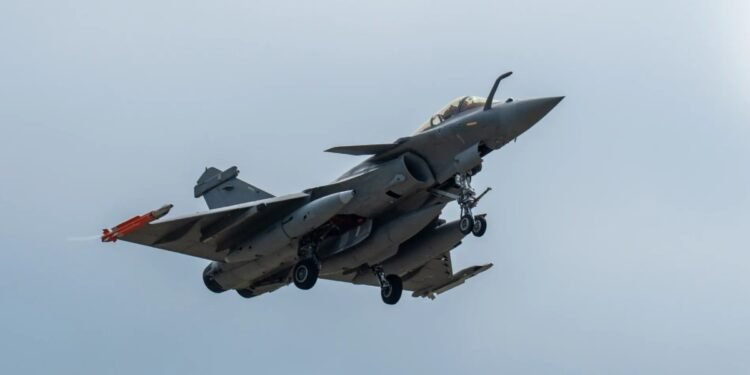
France has achieved a major milestone in the development of its next-generation air-to-air missile after successfully launching the MICA NG from a Rafale fighter operating at supersonic speed. The test marks a critical step toward bringing the advanced missile into operational service with the French Air and Space Force.
The latest firing was conducted at the Mediterranean test range operated by the French defense procurement agency (DGA) and involved close cooperation between MBDA, DGA, Dassault Aviation, and the French Air and Space Force. It was the second developmental launch of the MICA NG and followed an earlier successful firing from a Rafale in June 2025.
Unlike the initial trial, which focused on validating overall missile performance, this test specifically examined the missile’s infrared seeker during supersonic flight. The objective was to determine whether the seeker could reliably detect and track targets while exposed to the intense thermal conditions generated when an aircraft exceeds the speed of sound.
The infrared seeker serves as the missile’s guidance system in its heat-seeking configuration. After launch, it continuously tracks the heat signature of a target and adjusts the missile’s flight path accordingly. Testing this capability at supersonic speeds is particularly important because aerodynamic heating significantly increases the temperature around the missile, making it more difficult to distinguish enemy aircraft from the surrounding environment.
When a Rafale accelerates beyond Mach 1, friction with the air creates substantial heat around both the aircraft and the missile. This thermal background can reduce the contrast between the target’s infrared signature and its surroundings, potentially complicating target acquisition. According to French officials, the trial successfully demonstrated that the MICA NG’s infrared seeker can operate effectively under these demanding conditions.
The MICA missile family has formed the backbone of France’s short- and medium-range air combat capability since entering service in the late 1990s. Deployed on both Rafale and Mirage 2000 fighters, the original missile was produced in infrared and active radar-guided variants, allowing pilots to select the most effective engagement mode depending on the tactical situation.
The MICA NG builds upon that dual-seeker philosophy while incorporating modern technologies designed to address emerging aerial threats. The missile has been specifically developed to counter targets with reduced radar and infrared signatures, including drones, stealth aircraft, and advanced cruise missiles.
These threats present unique challenges for modern air forces. Small drones often have minimal heat emissions and extremely low radar visibility. Stealth fighters are engineered to reduce both radar reflections and thermal signatures. Meanwhile, highly maneuverable cruise missiles can execute evasive flight profiles that place heavy demands on interceptor performance and guidance systems.
To address these challenges, the MICA NG introduces a new generation of sensors, upgraded electronics, and enhanced propulsion technology, providing improved detection, tracking, and engagement capabilities compared to its predecessor.
Although French authorities have not disclosed a formal service-entry timeline, the progression of the test campaign suggests the program is advancing steadily. Missile qualification programs typically require numerous launches across a wide range of operational scenarios before entering service, and validating seeker performance during supersonic flight represents one of the most demanding stages of development.
The successful test also underscores France’s position among a small group of nations capable of independently designing, developing, and manufacturing advanced air-to-air missiles. Through MBDA, Europe maintains a sovereign missile-production capability that reduces dependence on foreign suppliers and export approvals.
As defense modernization accelerates across Europe, the MICA NG is expected to become a key component of France’s future air combat arsenal, ensuring that Rafale fighters remain equipped to confront increasingly sophisticated airborne threats in the decades ahead.