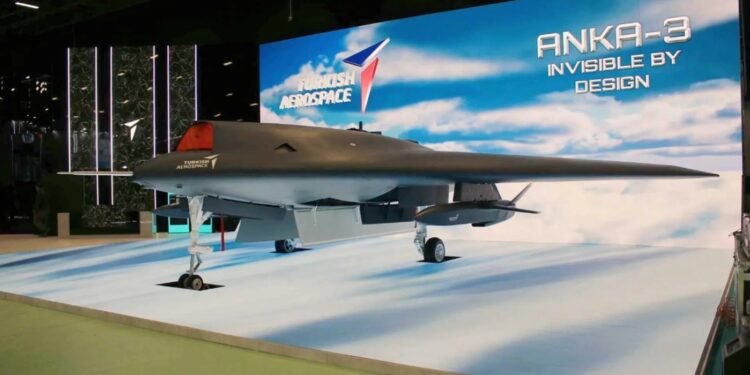
At SAHA Expo 2026, Türkiye showcased a significant evolution in its unmanned combat strategy by presenting the TAI Anka-3 equipped with two Süper Şimşek UAVs mounted under its wings. The configuration signals a clear shift toward highly distributed, networked air operations designed specifically for environments protected by dense and modern air defense systems.
Rather than relying solely on traditional reconnaissance or precision strike roles, this new setup highlights Ankara’s move toward integrated strike ecosystems where stealth platforms, electronic warfare assets, and expendable drones operate as a unified combat package.
The ANKA-3 configuration revealed at the exhibition reflects a broader doctrinal transformation in Turkish airpower thinking. Instead of deploying single high-value platforms into contested airspace, Türkiye is increasingly focusing on layered unmanned formations that can disperse risk while multiplying operational effects.
In this concept, the ANKA-3 remains outside high-threat missile engagement zones while launching smaller UAVs forward. These Süper Şimşek drones are designed to act as forward-deployed effectors—triggering enemy radar activity, disrupting sensors through electronic warfare, or executing one-way strike missions against exposed targets.
When combined with future integration plans involving the TF Kaan fighter and advanced electronic warfare systems, this approach aligns with a growing NATO-wide trend toward attritable unmanned systems intended to overwhelm adversary air defenses while preserving high-value assets.
Operational Concept Displayed at SAHA Expo 2026
At the exhibition, Turkish Aerospace Industries presented a full-scale ANKA-3 model carrying two Süper Şimşek UAVs on external hardpoints. This marked one of the clearest demonstrations yet of Türkiye’s intent to structure future combat air operations around modular unmanned strike packages.
Unlike earlier Turkish drone concepts focused primarily on operations in permissive airspace, this configuration is clearly optimized for heavily defended environments. Survivability in such scenarios depends on a combination of stealth shaping, distributed effects, and electronic disruption rather than traditional penetration alone.
The arrangement also builds on ongoing efforts to integrate ANKA-3 into broader manned-unmanned teaming frameworks involving platforms such as the TAI Aksungur and other elements of Türkiye’s expanding UAV ecosystem.
Platform Characteristics and Design Philosophy
The TAI Anka-3 occupies a middle ground between conventional medium-altitude drones and crewed combat aircraft. Its tailless flying-wing design eliminates vertical stabilizers, reducing radar cross-section while maximizing internal volume for fuel and payloads.
Key characteristics include:
- Length: 7.9 meters
- Wingspan: 12.5 meters
- Maximum takeoff weight: approximately 6,500 kg
- High-subsonic performance envelope
- Endurance approaching 10 hours
- Operational ceiling around 40,000 feet
Current prototypes are powered by a Ukrainian AI-322 turbofan engine, while Türkiye continues developing indigenous alternatives such as the TF6000 and TF10000 engine families to strengthen long-term propulsion independence.
The aircraft features internal weapon bays and multiple external hardpoints, allowing operators to balance stealth performance against payload capacity depending on mission requirements.
The Role of Süper Şimşek in Modern Air Combat
The Süper Şimşek represents a highly adaptable, expendable UAV designed for modular mission profiles. Derived from target drone technology, it has been repurposed for modern electronic warfare and strike operations.
Its key characteristics include:
- Compact airframe measuring roughly 4 meters
- Lightweight design with around 200 kg takeoff mass
- Payload capacity of 35–50 kg
- High-subsonic speed approaching Mach 0.85
- Operational altitude near 35,000 feet
- Range up to 900 km in air-launched profiles
Depending on configuration, it can carry electronic jammers, radar decoys, infrared signature enhancers, countermeasure systems, or one-way attack payloads.
By launching these UAVs from platforms like ANKA-3, operational reach is significantly extended, as the carrier aircraft provides altitude, speed, and forward positioning before deployment into contested zones.
The ANKA-3 is increasingly being positioned as a multi-role node within a broader combat network. Additional planned systems include EO/IR targeting suites, IRST capabilities, COMINT/ELINT systems, and electronic attack payloads.
This transforms the platform into more than a strike drone—it becomes a networked command-and-control node in the sky, capable of coordinating reconnaissance, electronic warfare, and precision strike operations simultaneously.
During the World Defense Show 2026, demonstrations even showed the TF Kaan operating alongside multiple ANKA-3 units in coordinated formations, where the manned fighter supervised targeting and engagement decisions while unmanned platforms extended sensing and strike coverage.